Bloodletting on a Cabbage Leaf
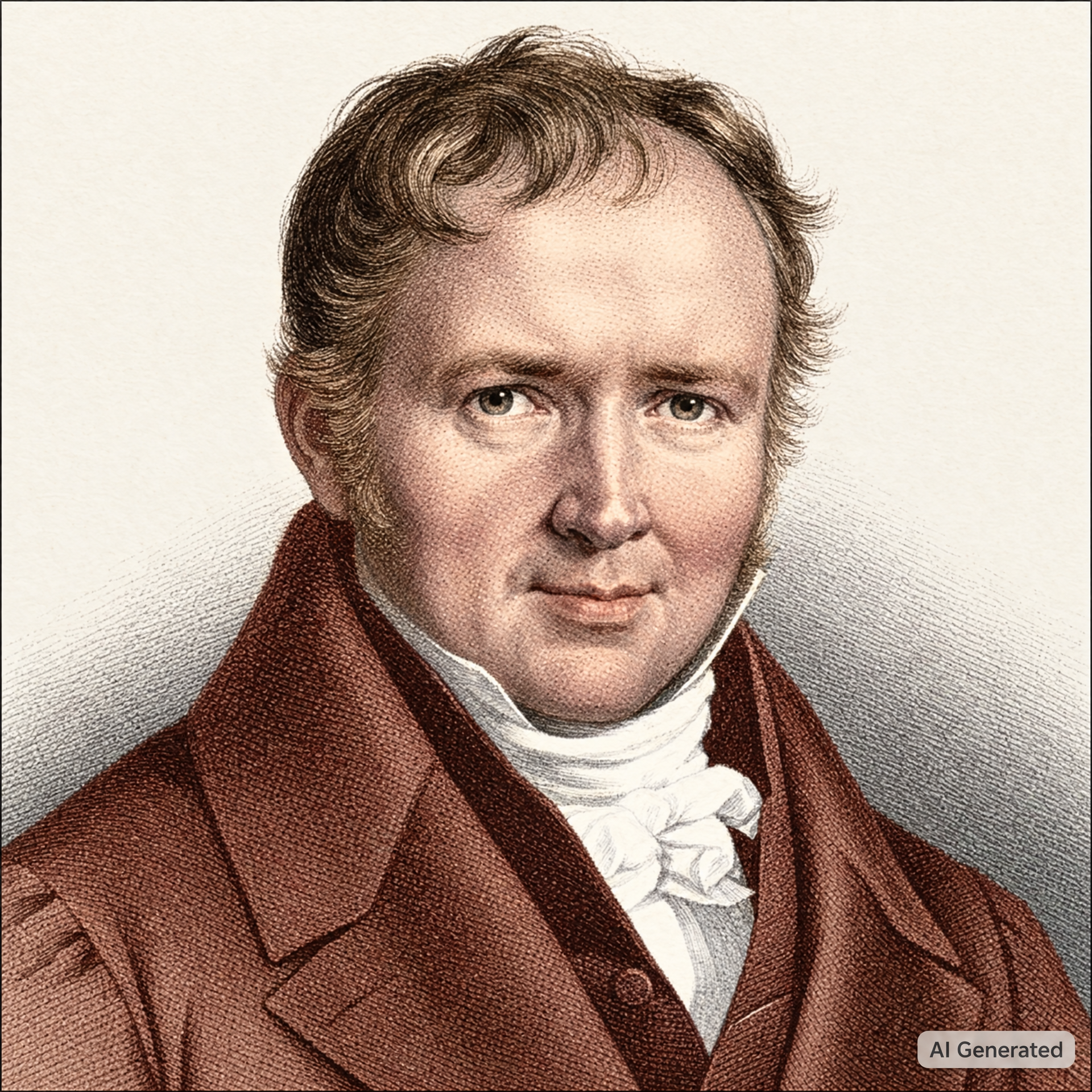
It is the 1790s in Fontainebleau, fifty-odd kilometres south of Paris, and a boy in his teens is bent over a cabbage leaf. In his hand is a lancet, the small pointed blade with which surgeons open a vein. His uncle means to make a surgeon of him and has set the exercise. The ribs of the leaf stand in for the veins of an arm, and the task is to prick one cleanly. Whoever can hit the vein of a cabbage will, in time, be allowed near people.
The boy was Siméon Denis Poisson, and he was all thumbs. Even so, he got far enough on cabbage to be trusted with applying blisters, the caustic plasters with which the sick were then treated. One of the first patients he attended on his own was dead within a few hours. The local doctors reassured him. That sort of thing, they said, happens often.
Poisson drew a conclusion that is rare among professionals. He quit. Back at home, among his father's official papers, he found the examination questions of the École Polytechnique in Paris, and at seventeen he was sitting in its lecture hall. The failed apprentice became the man whose name now hangs on equations, on distributions and on ratios – one of them a ratio for rock.
The scene is worth remembering. It has a hidden vein, a pointed instrument, a practice object on which everything works, and colleagues who declare the failure on the real case to be normal. People still drill for water, heat, gas and ore in exactly this way. The hidden veins of rock are tectonic fault zones, the fractures along which blocks of the Earth's crust have slipped past one another. They are the business of two guilds. Neither trusts the other.
Two Guilds, Two Truths
A geologist tells a story and a geophysicist solves an equation. Neither has seen the fault.
The geologist works from outcrops, the places where bare rock breaks through the soil. At one of them a bed of rock is found to be offset; at another, some way off, it is offset again. The two points are then joined on the map with a ruler. What lies between them, under field, forest and industrial estate, is conviction. On the printed sheet, nonetheless, the line looks as though it had been surveyed.
There is a difficulty of language too. To a geologist a fault is an event: something shifted here, millions of years ago. Whether the break gapes open today or has healed, and whether it holds water or clay, is a different question. Usually it is someone else's.
The geophysicist calls this reading tea leaves, and proceeds differently. Waves are sent into the ground and the time they take to return is measured. But travel times become a picture only when a model of the rock is fed in with them, and the textbook model is touchingly simple. Its rock is homogeneous, the same at every point, and isotropic, the same in every direction. Two elastic constants and a density describe it completely. A fault zone is the exact opposite: broken, layered, soaked, and different in whichever direction it is crossed.
So the inevitable happens. Where the geologist has drawn a line, the geophysicist measures nothing. Where the geophysicist records an anomaly, the map is blank. Each takes the other's finding for an error of measurement. The client is left to choose between them.
Poisson's Legacy: Two Waves and One Number
The physics on which the geophysicist relies comes, as it happens, from the failed surgeon. In 1828 Poisson worked out that two kinds of wave travel through a solid body. In one, the material moves back and forth along the line of travel, as a shunt passes down a row of railway wagons. In the other it moves from side to side, as a flick runs along a rope. Seismologists call them P waves and S waves, primary and secondary, because the first always arrives before the second.
How fast each one travels is set by the density of the rock and by two elastic constants, one measuring its resistance to being squeezed and the other its resistance to being sheared, pushed sideways out of shape. Both constants govern the compressional wave, the P. The shear wave, the S, lives on shear stiffness alone – and water has none. So the more shattered a rock is, and the wetter, the more sluggish its shear wave becomes, while the compressional wave still runs through cheerfully.
The ratio of the two speeds hangs on a single number, Poisson's ratio. It says how much thinner a body becomes when it is stretched. Pull a bar until it is one per cent longer and, if the ratio is one quarter, it becomes a quarter of one per cent thinner.
And here the story turns. Poisson's theory of 1829 gave exactly one quarter, for every solid material there is. In that case the compressional wave would be faster than the shear wave by a factor of the square root of three everywhere, in granite as in clay. By the time the slow wave had covered four kilometres, the fast one would always have covered nearly seven. The ratio would say nothing about the rock.
Reality did not comply. In 1848 the physicist Guillaume Wertheim measured about one third in glasses and in brass; in 1859 Gustav Kirchhoff found 0.295 for steel. The number is useful, then, only because the man it is named after got it wrong. If the quarter were a law of nature, no geophysicist could tell wet rock from dry. That is worth recalling whenever a model is mistaken for the ground it describes.
The Ring Test: What a Hairline Crack Does to the Tone
What a fault zone does to a wave can be shown at a kitchen table. Tap a sound porcelain plate with a fingernail and it sings, bright and long. Tap one that has a hairline crack and it answers with a thud. The crack may be quite invisible, even through spectacles and against the light. The ear finds it in half a second. In this comparison the geologist is the one holding the plate up to the window. The geophysicist does at least tap it, but then only times how long the sound takes to cross from rim to rim. Neither attends to the tone. Yet that dull thud contains the whole physics of a fault zone.
It begins with pitch. A plate has natural frequencies, the notes at which it rings of its own accord, and they are fixed by its shape, its thickness and its stiffness. The waves that run through it are guided between its two faces, and their behaviour depends on the frequency multiplied by the thickness. In the laboratory, the complete elastic tensor of a small sample – the full table of its stiffnesses in every direction – is extracted from just such resonances. A crack detunes the instrument.
Then there is the dying away. A wave loses energy every time it is scattered, whether by a grain boundary, a pore, a crack or an inclusion of foreign material. The sound plate offers few such obstacles and so it rings on. In the cracked one the tone is swallowed. A fault zone consists of little else but cracks and pores, so the signal is at its worst precisely where knowledge is most wanted. But that weakness is itself the information.
The rattle follows. Struck hard, a cracked plate distorts the wave and generates overtones, notes at multiples of the original pitch. This nonlinearity, as physicists call it, responds to microscopic cracks more sensitively than wave speed does, and by orders of magnitude. Anyone who merely times the journey of a wave is measuring with the bluntest tool in the box.
A crack also leaves the plate softer in one direction than in another. In rock, two elastic constants then no longer suffice. A whole stiffness tensor takes their place, and in every direction three waves travel at three different speeds. Even a cubic crystal, the most symmetrical of all, is anisotropic to sound, carrying it faster along some axes than along others. How isotropic, then, is a mass of rock full of aligned fractures? Hardly at all.
Last come the boundaries, and these guide waves along themselves. Love waves, which take their name from the mathematician who described them, exist only where a slow layer lies on a faster one. Stoneley waves creep along the join between two solids. A fault zone is a slow, crumbly strip between two fast blocks. It is a waveguide, a channel that traps waves and carries them along its length, and it has notes of its own which give away its width. That is the idea behind resonance imaging of fault zones.
The comparison limps in one respect. A plate can be held in the hand; a mountain can only be struck from outside and listened to at a few points. But the listening has first to be wanted. Poisson would probably have liked the image. By his own account he had been studying oscillations since infancy. When his nurse went out, she hung him from a nail in the wall so that the animals on the floor could not harm him, and there he kicked and swung to and fro. It was his first work on the pendulum.
Shake or Tap: How the Energy Gets into the Ground
How a mass of rock is set ringing is no side issue. It is the real difference between the methods.
The standard one is called vibroseis. Lorries weighing many tonnes lower a steel plate on to the ground and shake it, sending down a gliding tone that climbs from low to high over many seconds – the sweep. Geophones, small ground microphones planted along the survey line, record what comes back.
A tone that lasts for seconds gives no sharp echo, so the recording is afterwards matched against the signal that was sent until the long howl has been turned back into a short pulse. What remains are reflections, echoes from the boundaries at which density or wave speed changes abruptly. The thing measured, in the end, is the travel time of an echo, and from many travel times comes the familiar striped picture of the underground.
The method was made for layers lying flat, and there it is good. At a fault zone it reaches its limit, for three reasons.
- A steep, shattered zone is not a mirror. It returns no clean echo; it scatters and swallows, and in the picture it appears at best as a step in the stripes and at worst as a faded patch.
- Depth is not cheap. A reflection pays for every metre twice, once on the way down and once on the way up, and along the way the high notes die first. What returns from great depth is a hum, and fine lines cannot be drawn with a hum.
- The processing treats as noise everything that is not an echo of the sweep: the waves guided along the layers, the ringing-on, the overtones. All of it is filtered out.
The very signals in which a crack gives itself away are discarded, and the travel time is kept.
Behind this lies an attitude, that more is better. The sweep runs through the whole band of frequencies whether or not the ground answers at any of them, and most of the energy ends up where nothing resonates. It is like looking for the crack in a plate by blasting it with a siren and timing the echoes.
But there is another way, and it is the ring test. Instead of shaking the ground, one taps it – very locally, with little energy, at regular intervals – and evaluates the resonances and nothing else. The echo is beside the point. What counts is the natural tone: the frequencies at which the ground resonates at this spot, how strongly, and for how long. Every child in a playground learns that little energy is enough for this. Nobody sets a swing going with an excavator. It takes small pushes in the right rhythm, and when they match the swing's own frequency the arc grows out of all proportion to the push.
Little Energy, but Still Remarkable Depth?
Can so little energy travel far? The sea shows that it can. Somewhere beyond the horizon a storm is churning up a jumble of short waves and long ones. Then the ocean sorts them. Long waves run faster than short ones, and they hurry away from the chaos. What arrives at a distant coast is the swell – ordered, slow and long. So little is lost on the way that after a good three thousand kilometres, about the width of the North Atlantic between Newfoundland and Ireland, it still carries more than a third of its energy.
Out on the open sea nobody would guess. The water rises and falls, nothing more. Only where the seabed shelves upward does the same energy have to pass through less and less water. The wave grows steep and high, and suddenly there is surf on a beach, thousands of kilometres from the storm that caused it.
There are two lessons in this, and both hold in rock. Range depends on wavelength and order far more than on force: the short, disordered noise dies early and the long, ordered oscillation travels. And the energy shows itself only where the medium changes. A fault zone is the coastline of the underground.
Rock, however, has something that the ocean lacks. The ground is no dead block. It is a stack of differently bedded layers, and some of them are thixotropic – like ketchup that will not pour until the bottle is shaken, they lose their strength as soon as they are set in motion and regain it at rest. The whole stack, moreover, is under stress, pre-tensioned like a string. A slack string stays mute. A taut one sings at the lightest pluck, because the energy has long been in it.
The resonance-based approach relies on exactly that. It does not have to force energy down and haul it back up as an echo. It nudges what is under tension down there already and listens to the answer. Each layer answers according to its bedding and its state of stress, and the fault zone, a crumbly wet strip, answers with a dull note of its own.
In the experience of the authors of this account, the approach sees considerably deeper than classical reflection seismics, the echo method, ever could. It also shows the condition of the rock and not merely its geometry. One method says where a boundary lies; the other, what is going on there. It should be said plainly that this view is not widespread, and that the authors are an interested party: their own method has used the principle in the field for fifteen years.
Why has it not spread? Geologists, when in doubt, avoid the mathematics, and without mathematics resonance remains a word. Geophysicists know the matter perfectly well, since natural oscillations and guided waves are in their textbooks. But for a long time there were hardly any technical means of testing, in the field, the assumptions on which resonance-based measurement rests. What cannot be tested is not taught, and what is not taught nobody orders. Fifteen years of practice do not replace a textbook proof. But fifteen years in the field are no cabbage leaf either.
Geothermal: Enemy on the Way Down, Treasure at the Bottom
What it costs to miss the tone is seen first in deep geothermal energy, the tapping of hot water from far underground. There a fault is two things at once: the enemy on the way down and the treasure at the bottom.
A well that runs into a fault unawares has a problem that no expert report can mend. The drilling mud, the dense fluid pumped down to cool the bit and carry up the cuttings, vanishes into the shattered rock. The wall of the borehole caves in. The drill string, the long column of steel pipe that turns the bit, sticks fast. And in the worst case pressure comes up that nobody had reckoned with. A cracked plate is the last thing anyone wants under the bit.
At the target depth, however, the matter is reversed. There it pays to steer the angled side branches of the well deliberately into the fault, because its open fractures usually yield water very generously – and, at the right depth, at the right temperature too. The same structure that ruins the well higher up is what makes it pay lower down. So it has to be known twice: once to be avoided and once to be hit.
For that, neither the line nor the standard picture is enough. The geologist's line does not say at what depth the fault will cross the path of the well, nor whether it gapes or was long ago cemented shut with clay and minerals. Conventional seismics shows where layers are offset against one another – geometry, not condition.
The answer is in the tone. Open, water-filled fractures slow the shear wave and swallow its energy. They also split it into two parts that travel at different speeds, according to the direction in which each vibrates. A cemented zone is stiff again, and sounds it. A method that hears the difference before the first metre is drilled therefore does double duty. It is risk management for the drilling, because it says where a well must not pass unawares. And it is provision for a discovery, because it says where the well has to end.
In practice the geologist delivers the location without the condition and the geophysicist a picture without the water. Drilling goes ahead all the same. If it goes wrong on the way down, that is called drilling risk. If the bottom is dry, it is called exploration risk – as though both were weather. The doctors of Fontainebleau would have recognised the reasoning. That sort of thing happens often.
Drinking Water: Three Metres Off Is Dry Too
With drinking water the same game is played in miniature. In hard rock the water is not in the stone but in the crack, and a borehole that misses the fracture is dry. Three metres to one side is dry too. Everyday speech, with good reason, talks of water veins. To a well driller a fault is sometimes a vein and sometimes a dam, depending on whether it is open or tight. The 1:25,000 map is of about as much help in finding it as a road atlas is in finding a parking space, since a line half a millimetre thick on the sheet covers a good twelve metres of ground, the length of a city bus. So the geologist is right, and the well is empty.
Yet at shallow depths the ground could be listened to very well. Surface waves, which travel along the top of the ground and not down through it, are dispersive where the ground is layered: each frequency reaches down to a different depth. Tuning through the band of frequencies therefore sounds the ground without a single hole being made, and a wet zone of shattered rock stands out by its low shear-wave speed – the dull patch in the sound picture. But geologists regard such a measurement as playing with numbers, and for geophysicists a domestic well is too small for the budget. In the end the farmer stands in the meadow with a dowser, who also stabs at veins that cannot be seen. A dowser, at least, does not cost much.
Subsidence: Here the Crack Is Feared
Not everyone wants the crack. Builders fear exactly what geothermal engineers and well drillers go looking for. With sinkholes and subsidence the danger is a hole, and holes are not on any geological map. A map shows what is there, not what is missing. Along faults water migrates, dissolves, washes out and loosens the rock. A geologist can say where such a thing is possible in principle. When it will happen, and under which house, the map does not say. Yet this is the very case the tap test was invented for. Nobody buys a plate because it looks sound in the drawing.
To a wave, a cavity is hard to overlook. It has no shear stiffness, the contrast with the surrounding rock is harsh, and the scattering is strong. The loosened zone around it ought to announce itself earlier still, because microscopic cracks alter the nonlinear signals, the overtones, far more strongly than they alter the speed. The plate rattles long before it breaks. Materials testers have long used the effect to catch components before they fail. On building land, people prefer to make do with a report based on the map. They do so until the road has gone. Then both guilds turn up and explain, in unison, why this was to be expected.
Oil and Gas: Trap, Seal or Leak
With oil and gas the question becomes a game of chance with three squares. To a petroleum geologist the same fault is, depending on the day, a trap, a lid or a drain – and the seismic picture does not say which. This is so even in an industry that lives by sending sound into the ground. Its pictures show the offset of the layers pin-sharp. Whether the crack is cemented and holds tight, or whether gas has been escaping along it for millions of years, is not written on them.
Here Poisson's number comes into its own. Oil, gas and water have no shear stiffness. They change how easily a rock can be squeezed but hardly at all how easily it can be sheared, so whatever fills the pores acts on the compressional wave and leaves the shear wave largely cold. The ratio of the two speeds – ruled by the very number that Poisson fixed at one quarter for everything – becomes a fingerprint of what sits in the pores. Measuring both waves gives geometry and filling. Evaluating only the fast one gives a pretty picture and a dry well.
Ores: The Crack, Mended with Metal
That leaves the ores, and there the fault is the supplier. Hot solutions once rose through the fractures and left their cargo behind in the fissures. Japanese craftsmen mend broken porcelain with gold lacquer and call it kintsugi; nature does the same with its cracks, only without announcing it. This is the geologist's home ground. The vein is followed at the surface, the rock and its discolouration are read, and the continuation is drawn into the depths – with the ruler again.
The geophysicist, meanwhile, sees a dense, stiff body down below, because density and stiffness determine wave speed. But an ore vein is narrow. To a long wave it is an inclusion that scatters, not a layer that reflects. Waves also run along the boundary between the vein and the host rock around it, and in conventional processing they end up in the bin as noise. So one follows the vein that can be seen at the top and the other the lump that can be measured at the bottom. Whether the two belong together is decided by the drill bit.
The Bright Spot
Which leads back to Poisson. He calculated better than almost anyone of his time, and he never went and looked. His hands stayed as clumsy as they had been in his apprenticeship; he did not touch an experiment in his life. Life, he is supposed to have said, is good for only two things: discovering mathematics and teaching mathematics. Looking was not mentioned.
In 1818 the Paris Academy announced a prize on the nature of light. Augustin Fresnel, a young engineer, submitted a wave theory. Poisson sat on the jury and held light to be particles. He worked through Fresnel's formulas and found a consequence that he thought absurd: in the middle of the shadow of a round disc there would have to be a bright spot. For him that settled the theory.
His fellow juror François Arago did not argue. He stuck a metal disc two millimetres across, about the size of a match head, on to glass with wax and held it in the light. The spot was there. Fresnel received the prize, and the spot bears Poisson's name to this day – the name of the man who had calculated that it could not exist. It did not convince him. He stayed with particles until his death.
That is the whole dispute between geology and geophysics in a single experiment. The calculation was right, the conviction was wrong, and the matter was decided by a scrap of metal and a dab of wax. For the underground, the equivalent would be a short list of measurements:
- Shear waves as well as compressional ones
- Attenuation, the fading of a signal, as well as its travel time
- Dependence on direction where isotropy is now assumed
- Guided waves and resonances as well as reflections
- Overtones as well as speed
Tapping and listening would come first and drilling afterwards, as a check and no longer as a hope.
That leaves the cabbage leaf. The map and the textbook equation are the cabbage leaves of exploration: flat, tidy, with the veins on top. On the cabbage leaf Poisson had done everything right, and the first real patient died all the same. His colleagues found that ordinary. He drew the consequence and changed his profession. In the exploration business, after a dry well, only the drill site is changed.
Below is a more technical paper with the last 15 years in the fields of acoustics and seismic research.