
Geothermal Cooling: What the Ground Can Do for a Data Centre
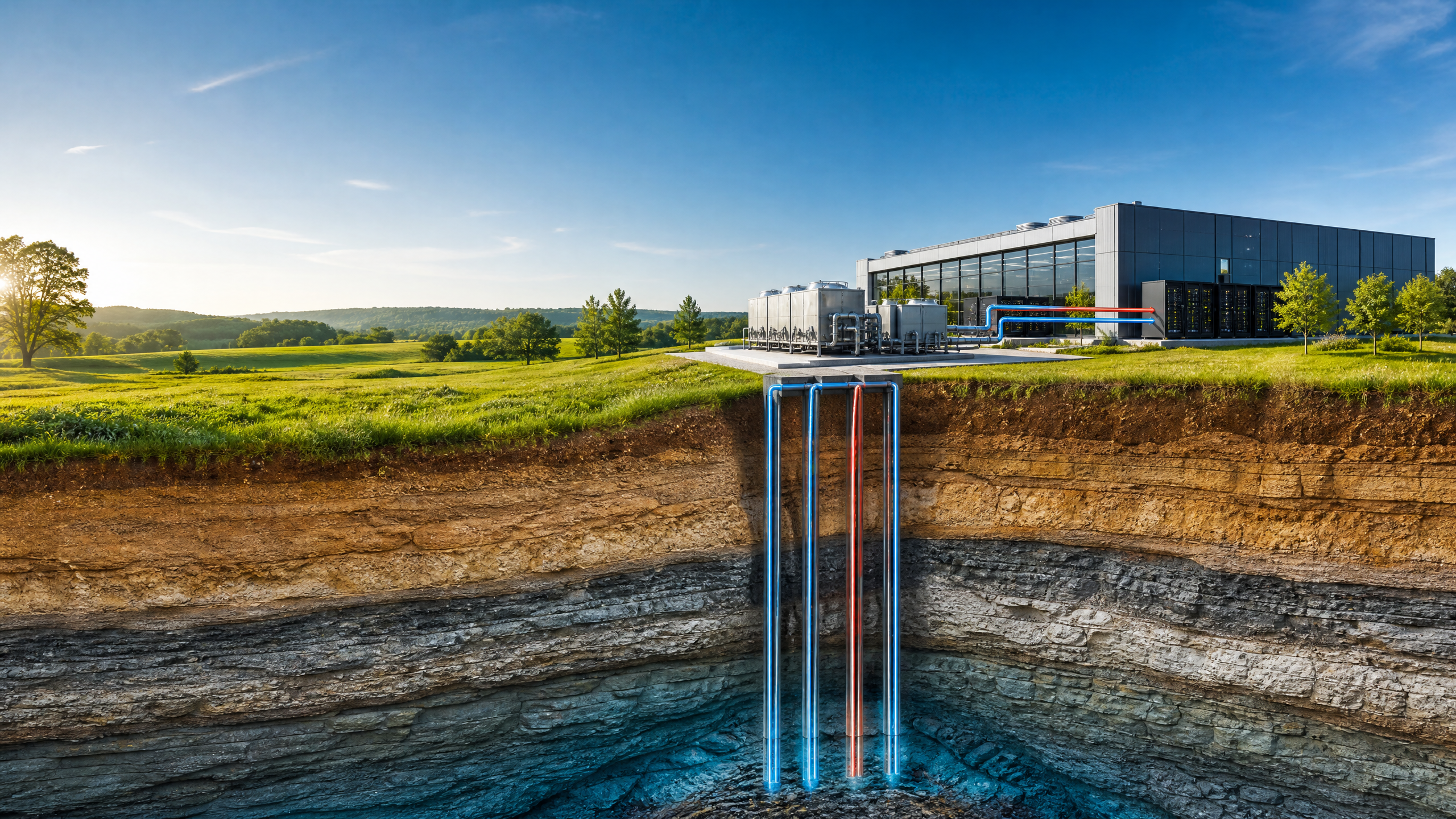
Stable temperatures, local geology and the difference between a promising concept and a bankable design
17 June 2026 · micara Subsurface Team
On a hot afternoon, the air above a data-centre site may be difficult to ignore. Fans work harder. Mechanical cooling consumes more electricity. The grid is already carrying the demand of homes, offices and industry responding to the same heat.
Ten metres below the surface, the day is almost irrelevant. The ground does not follow every swing in weather. Seasonal temperature changes fade with depth until the subsurface offers what the atmosphere cannot: a comparatively stable thermal environment throughout the year.
This simple contrast explains the attraction of geothermal cooling. Data centres produce heat continuously and must remove it reliably. The ground can absorb, exchange or store part of that thermal load without becoming hotter simply because the afternoon air has done so. Yet the opportunity is never generic. The question is not whether geothermal cooling works in principle. It is whether the geology, groundwater, land, regulation and operating profile beneath a particular site can support it.
The physics is simple; the capacity is local
Below the shallow zone affected by daily and seasonal weather, ground temperature remains relatively stable. Ground-coupled heat exchangers can use this environment to pre-condition a cooling circuit. Groundwater systems may move heat through productive aquifers. Heat pumps can raise or lower temperatures where direct exchange alone is insufficient, while conventional cooling remains available for peaks or redundancy.
The thermodynamic advantage is clearest on the days when air-based systems are least comfortable. As ambient temperature rises, dry coolers and chillers work under more demanding conditions. A ground-coupled source does not experience the same daily extreme. That can reduce cooling energy, lower peak electrical demand and improve the stability of the system's performance.
But the word ground conceals enormous variation. Thermal conductivity changes between rock, saturated sediment and dry fill. Groundwater flow can carry heat away, but only if the aquifer has adequate yield and the hydrochemistry does not create operating problems. Boreholes compete for subsurface volume, and the thermal influence of one can reach another. Water-protection rules, neighbouring users and drilling conditions differ from parcel to parcel.
A regional geological map can indicate possibility. It cannot, by itself, establish capacity for a specific design.
Cooling load must be translated into a subsurface system
A data centre does not ask the ground for an abstract amount of cooling. It imposes a load through time. The useful design questions are therefore temporal as well as spatial: how much heat must be rejected during an ordinary hour, what happens during a peak, how continuous is the load and where does the heat go over a year?
If heat is placed into the same subsurface volume continuously without sufficient natural movement, seasonal recovery or deliberate extraction, the ground around the system gradually warms. Performance then declines. The design must account for long-term thermal balance, not merely the first summer of operation.
This is where a cooling concept becomes an engineering model. It connects IT load, supply and return temperatures, heat-exchanger performance, pump energy, land area, borehole spacing, groundwater movement and backup capacity. A system that appears efficient at one operating point may look different at part load, during maintenance or after years of thermal accumulation.
Regulation has made subsurface cooling strategic
Germany's Energy Efficiency Act gives data-centre efficiency and waste heat a sharper commercial significance. PUE requirements put pressure on supporting energy consumption. Waste-heat provisions ask operators to consider how the heat produced by compute can be made available for use.
Geothermal infrastructure can connect these two problems. The subsurface may provide a low-temperature sink that reduces cooling energy. In suitable designs, it may also serve as part of a seasonal thermal strategy: heat is stored or balanced so that it can contribute to winter demand or another useful process.
Where a district-heating network, campus or industrial user is nearby, the cooling system and the heat-utilisation concept may share equipment and infrastructure. The heat that is a burden inside the data centre becomes potentially useful beyond it. Yet distance, delivery temperature, seasonal demand and commercial responsibility still decide whether that opportunity is real.
The presence of heat does not create an offtaker. Nor does a legal objective suspend the laws of thermodynamics.
What investors need to verify
A geothermal cooling concept often appears early in a project, when little site-specific evidence exists. At that stage, attractive percentages and generic performance claims can enter the financial model long before the ground has been investigated.
The investor's question should be direct: what evidence shows that this subsurface can deliver the assumed capacity, at the required temperatures, for the intended operating life?
Sparse boreholes and regional data may provide initial indications. They can still leave uncertainty about structures between points, groundwater pathways, variable strata and the usable area of the site. Non-invasive subsurface surveys can add spatial understanding before a major drilling campaign. They help identify zones that appear more or less favourable, direct validation work and reduce the chance that an early design is extrapolated from an unrepresentative point.
This sequence matters financially. Information gathered before acquisition or layout freeze can influence price, land allocation and system architecture. The same discovery after construction begins may lead to additional drilling, a reduced geothermal contribution or emergency investment in conventional cooling.
Where geothermal cooling is realistic
Enthusiasm is least useful where honest capacity limits are needed. Shallow geothermal systems may be especially attractive for facilities in the low- to mid-double-digit megawatt range where sufficient land, groundwater or favourable rock is available. As loads increase, the ground may become one layer in a hybrid cooling system rather than the sole heat sink.
Hybridisation is not failure. It may be the most resilient design. Ground-coupled cooling can carry an efficient base load while other technologies handle peaks, maintenance and extreme conditions. The correct proportion depends on subsurface capacity, rack-density trajectory, redundancy requirements and the value of electrical peak reduction.
Constraints must be recognised early. Water-protection areas may restrict drilling or groundwater use. Existing geothermal neighbours may already influence the thermal field. Limited land can restrict borehole spacing. Poor water chemistry may complicate open-loop systems. Future expansion can change the load beyond what the initial field was designed to carry.
Each constraint can be investigated. None should be removed by assumption.
Four disciplines, one design
Geothermal cooling sits where geology, engineering, regulation and finance intersect. Geology determines whether the resource and subsurface geometry are suitable. Engineering determines how that resource is connected to a cooling system and monitored over time. Regulation shapes water use, drilling, energy performance and the security scope of new operational technology. Finance determines whether capital cost, operating savings, risk and residual value support the investment.
If any one discipline works alone, the concept remains fragile. A geological resource without an integrated cooling design has no operating value. An efficient design without permits cannot be built. A compliant project without long-term thermal balance may deteriorate. A financial model without site evidence turns technical hope into apparent return.
The ground offers a stable temperature, but not a standard product. Its usefulness must be measured at the parcel, converted into an operating design and carried into the investment case. Only then does geothermal cooling cease to be an attractive diagram and become part of a data centre that can be financed, built and relied upon.