
Deep Geothermal Energy: Drill and Ye Shall Find – Mostly
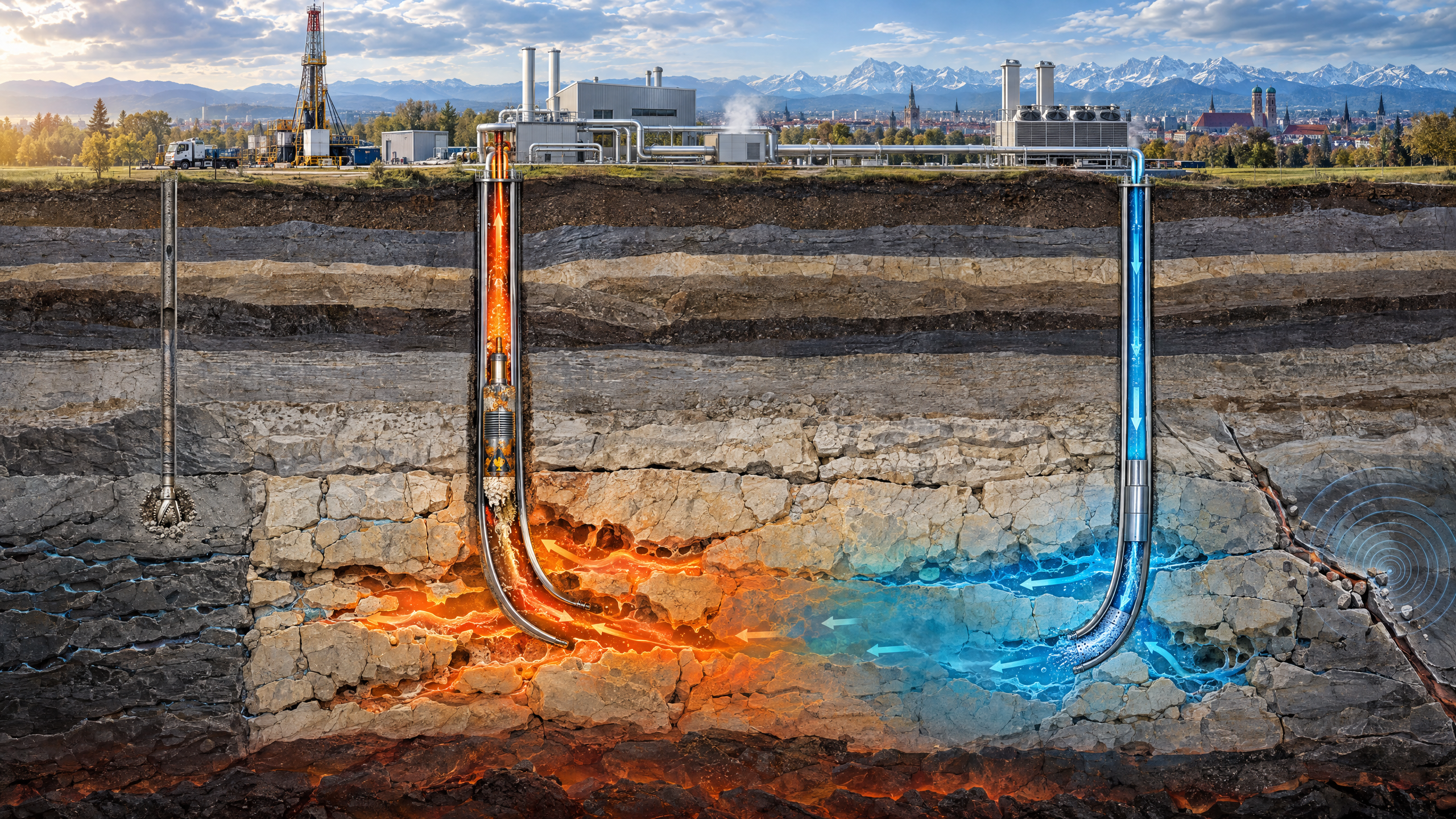
A single day of drilling costs up to 80,000 euros. And whether it was worth it, you only find out once the first well has reached its target depth. Until then, everything is a forecast. Deep geothermal energy promises heat that flows around the clock without burdening the climate. But only if three things are right underground at the same time. The target aquifer has to be there, it has to yield enough water, and the production and injection wells have to work together cleanly in hydraulic terms. If one of these is missing, the other two are no use.
We have compiled the classic problems of geothermal exploration in a detailed report. Here are the key points in brief.
The most expensive moment of truth
Flow rate and temperature, the two quantities everything revolves around, exist before drilling only as probability distributions. The subsurface doesn’t deliver numbers to order. In the Malm near Munich, the geological probability of success is around 90%. In new areas without data, you start at about 25% – worse odds than a coin toss. In the Bavarian Molasse Basin, only one of around 60 wells had failed by 2017. A splendid track record, but it can’t be transferred to regions with no drilling history. Anyone who plans there with Bavarian success rates is getting rich on paper only.
A record – just not for water
At 6,034 m, the well in Geretsried was the deepest geothermal well in Europe. 100–120 l/s were expected; the first pump tests delivered around 10 l/s. What went wrong? The site wasn’t dry. It failed on reservoir quality: towards the south, porosity and permeability decrease, and the fractures contributed less than hoped. The Holzkirchen well, completed at about the same time and at a similar depth, achieved a sustained 50 l/s at 150 °C. Similar depth, completely different result.
Water has a mind of its own
Thermal water is never just water. In the Molasse Basin it deposits limescale, because the pressure drop during production upsets the carbonic acid equilibrium – on pumps, risers and heat exchangers. In the Upper Rhine Graben, barite and sulphides precipitate, and the barite comes with an unwelcome extra: natural radioactivity. Almost in passing, the heating project becomes a case for radiation protection. Then there are saline brines that attack steel, and dissolved gases that make pumps sputter. Water chemistry therefore belongs in the feasibility study, not in the small print.
The pump: an heirloom from the oil field
The electric submersible pump is the most critical component of the entire operation – up to 36 m long and eight tonnes heavy. It comes from the oil industry, and in geothermal service it has to cope with higher temperatures, larger volumes, calcareous and saline water and changing loads. The first problems can appear after just a few months, and replacing a pump costs up to 0.5 million euros. An example from Germany shows it can be done better: a solids-protecting intake tripled the run time and cut power consumption by 18%. And there’s another lesson here: anyone who sizes the pump for the hoped-for rather than the tested productivity index will pay for it later, down the hole.
Not too close, not too far
Production and injection wells have to talk to each other hydraulically, but mustn’t get too close – otherwise the cooled water turns up at the production well too soon. In Bavaria, a spacing of around 2 km is considered sufficient for 50 years and more. In multi-layered sandstones such as those near Hanover, 500 m can suffice for 30 years. The physics behind it is merciless: double the flow rate and you halve the time to thermal breakthrough. More water simply also means cold water sooner.
When the earth shakes
Induced seismicity is the risk the public notices most. In St. Gallen in 2013, around 1,200 m³ injected to control a gas kick were enough to trigger a felt earthquake of magnitude 3.5. In Pohang (South Korea) in 2017, a quake of moment magnitude 5.5 injured dozens of people, and more than 1,700 residents had to move into emergency shelters. Traffic light systems that only look at the strength of the tremors were not enough there. What’s called for are adaptive systems that continuously take in new information about the faults underground.
Handing the risk to someone else
Since 18 December 2025, Germany has had KfW programme 572. It offers loans of up to 25 million euros per project, insurance against exploration failure from Munich Re covering 30–70% of the loan amount, and a partial debt waiver from KfW for the rest – together up to 100% cover. Only those who have their data in order can get insured, though. And what does the policy cover? Exactly what its name says: the drilling and the test. Not the pumps, not the scale, not the long-term depletion of the reservoir, and as a rule not the cost of a delayed permit either. The Bavarian Association of Municipalities considers the insurance sensible but not sufficient. There’s simply no policy against red tape.
Finding it is only the beginning
The classic problems of geothermal energy are neither new nor unmanageable. They are, however, linked like a chain. An uncertain depth forecast shifts both temperature and flow rate. An overly optimistic productivity index leads to a wrongly sized pump. And too small a well spacing buys good hydraulics at the price of cold water. Whoever has found hot water still has to produce it for decades.
You’ll find the full report – with the calculation method from the BVEG/DGMK guideline, the case studies of Geretsried, St. Gallen and Hanover see the attached German white paper.