
From Microcontroller to Training Cluster: What Investors Miss About AI Compute
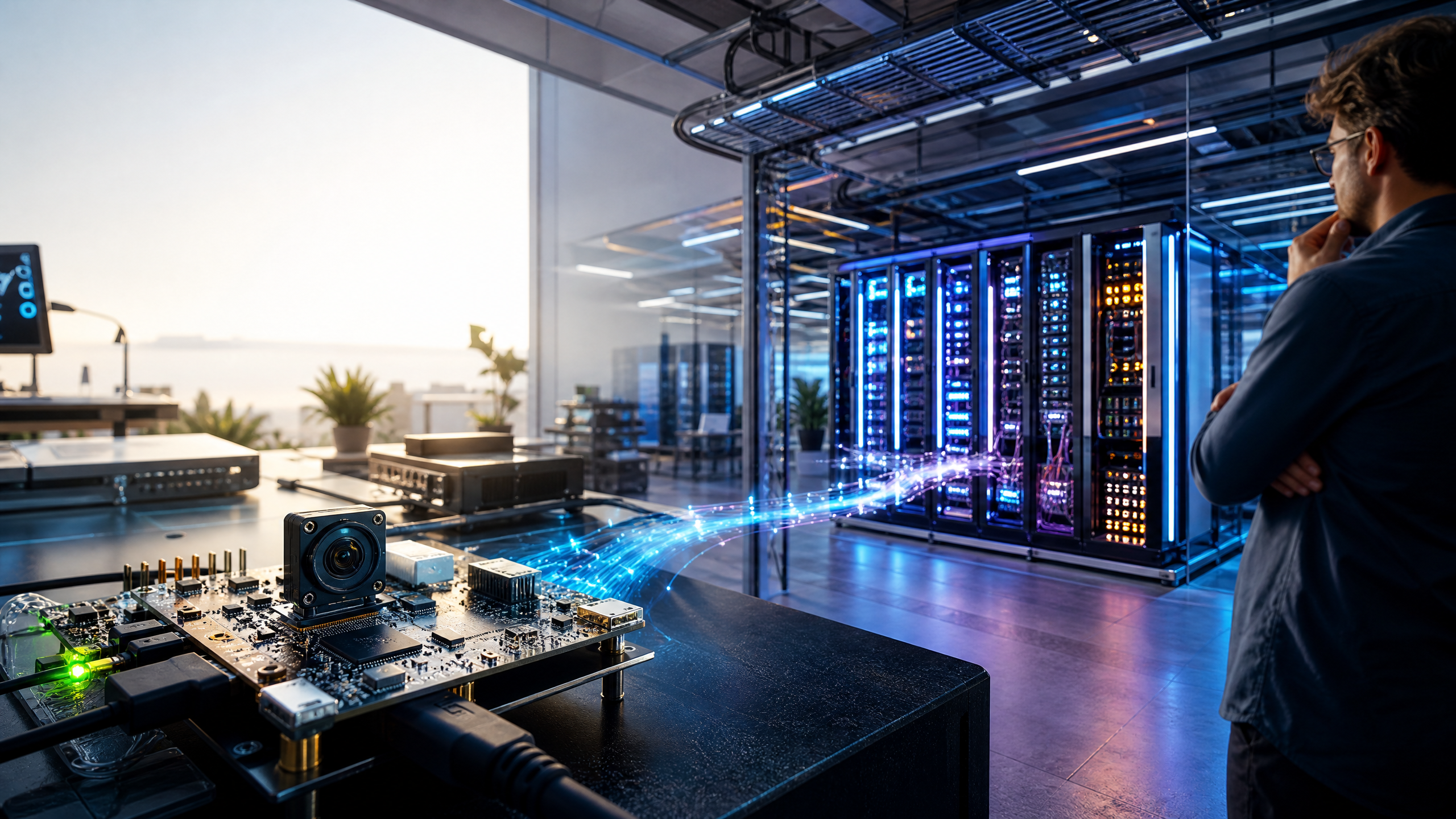
The workload behind the megawatts
10 June 2026 · micara Engineering Team
At one end of the AI industry, a microcontroller wakes for a few milliseconds. It reads a sensor, recognises a pattern and returns to sleep before its battery has reason to notice. At the other, thousands of accelerators exchange data at extraordinary speed, drawing enough power to shape substations, cooling plants and investment strategies.
Both systems perform machine learning. Economically, they could hardly be more different.
The present build-out of AI compute is among the largest infrastructure expansions of the decade. Capital is moving rapidly into chips, power capacity and data-centre campuses. Yet many investment models compress the entire market into one upward demand curve labelled "AI". They count megawatts without asking what work those megawatts will perform.
An engineering view begins elsewhere. It begins with workload, because workload determines hardware, interconnect, cooling, location, utilisation and the rate at which an asset loses its economic position.
Compute is not a commodity
Training and inference are often presented as two sizes of the same activity. They are better understood as different operating businesses.
Large-scale training brings vast datasets and model parameters together across many accelerators. It values the newest hardware, dense low-latency interconnect and high memory bandwidth. The workload can often tolerate more geographical flexibility than a user-facing service, but it is demanding about cluster architecture. A weak link in the network can leave expensive processors waiting.
Inference serves a trained model to an application or user. Latency, utilisation and cost per request become central. Some inference remains in large data centres, particularly for powerful general models. Other tasks can run on older accelerators, regional servers, mobile devices or embedded processors close to the sensor.
A facility designed for one profile does not automatically serve the other at the same economics. Rack density, cooling distribution, cable paths, floor loading, network topology and power quality all reflect the intended work. When a project is described as "AI-ready", the useful question is not whether it can host accelerators. It is which workloads it can host competitively, and for how long.
Hardware becomes obsolete economically before it fails physically
Accelerators seldom reach the end of their investment life because every chip stops functioning. More often, a new generation delivers enough additional performance per watt that the older fleet becomes expensive for the most valuable workload.
This is an economic event. Electricity, cooling and infrastructure are paid continuously. If a newer device completes substantially more work for the same energy, customers migrate even while the older machine remains technically capable.
Depreciation should therefore be modelled as a cascade. New hardware begins with flagship training. As it ages, it may move to fine-tuning, inference and specialised work with different revenue and utilisation. The length of that cascade depends partly on electricity price and partly on whether the facility can support the network and cooling requirements of the next generation.
The same GPU fleet can consequently carry different value in two buildings. In the first, low-cost power and flexible customers preserve a profitable second life. In the second, high energy cost and a rigid architecture accelerate displacement. A straight-line depreciation schedule cannot express this difference.
The edge absorbs work quietly
Cloud demand is visible because it appears as facilities, server orders and electricity consumption. Edge inference is dispersed. It appears in cameras, sensors, vehicles, phones, wearables and industrial equipment, often one small model at a time.
Modern microcontrollers and neural processing units can execute vision, audio and anomaly-detection tasks locally. The device does not have to send every raw signal to a central server and wait for a response. It can identify the useful event, transmit a compact result and continue operating even when connectivity is intermittent.
Each migrated task is inference demand that does not reach a central data centre in its original form. This does not remove the need for large-scale training, model distribution or cloud services. It changes the long tail of inference. Some workloads grow centrally; others move closer to where data is produced.
Investment models that extrapolate cloud inference without accounting for on-device capability risk confusing growth in AI use with equal growth in centralised compute. The two are related, but they are not identical.
The most consequential technology risk may sit around the chip
Accelerator roadmaps attract attention because the chips are expensive and familiar. Yet the facility around them may determine whether they can be used efficiently.
Rack power density has risen quickly. An air-cooled hall designed for an earlier generation may be unable to remove the heat of a dense liquid-cooled deployment without substantial modification. Retrofitting manifolds, heat exchangers, distribution units and monitoring while the asset is operating creates cost and interruption risk.
Interconnect imposes another physical discipline. Training clusters depend on high bandwidth and predictable latency between devices. Hall geometry, cable length, switching architecture and equipment placement are therefore part of compute performance. A building with sufficient power but an inflexible network layout may not support the cluster economics its capacity model assumes.
When a facility cannot follow the density or interconnect curve, it does not necessarily become worthless. It may move down the workload hierarchy and operate as an inference or less demanding compute site. The revenue, customer base and value will change. That transition should appear as a scenario before it appears as a surprise.
Power is not merely a capacity number
Two data centres can each have access to one hundred megawatts and still offer different compute economics. The price, carbon characteristics, reliability and ramp-up of that power matter. So does the fraction that reaches productive IT after conversion and cooling losses.
Performance per watt links the chip roadmap to the electricity contract. PUE links the server to the facility. Grid timing links the customer pipeline to revenue. The model must connect these layers rather than treating power as a binary condition that exists once a connection agreement has been signed.
The availability date is especially important in a fast hardware cycle. A delay does not only postpone revenue. It may cause a planned cluster to miss the commercial window of the generation for which it was designed.
What defensible assumptions look like
None of these observations argues against AI infrastructure. Demand for training, inference and supporting digital services is real. They argue for a more precise description of that demand.
A defensible investment case separates workloads, models hardware in generations, links economic life to energy cost, accounts for edge absorption and tests the facility against future rack density, cooling and interconnect. It gives older hardware a plausible second life instead of an automatic one. It shows what happens when the site moves from training economics to inference economics.
Above all, it asks what the asset is physically capable of doing. Megawatts are necessary, but they are not the product. The product is useful compute delivered at a competitive cost, with the network, cooling and reliability the workload requires.
The smallest edge device and the largest training cluster reveal the same principle. AI value is created not by possessing computation in the abstract, but by matching the right computation to the place, energy and system that can perform it well.